

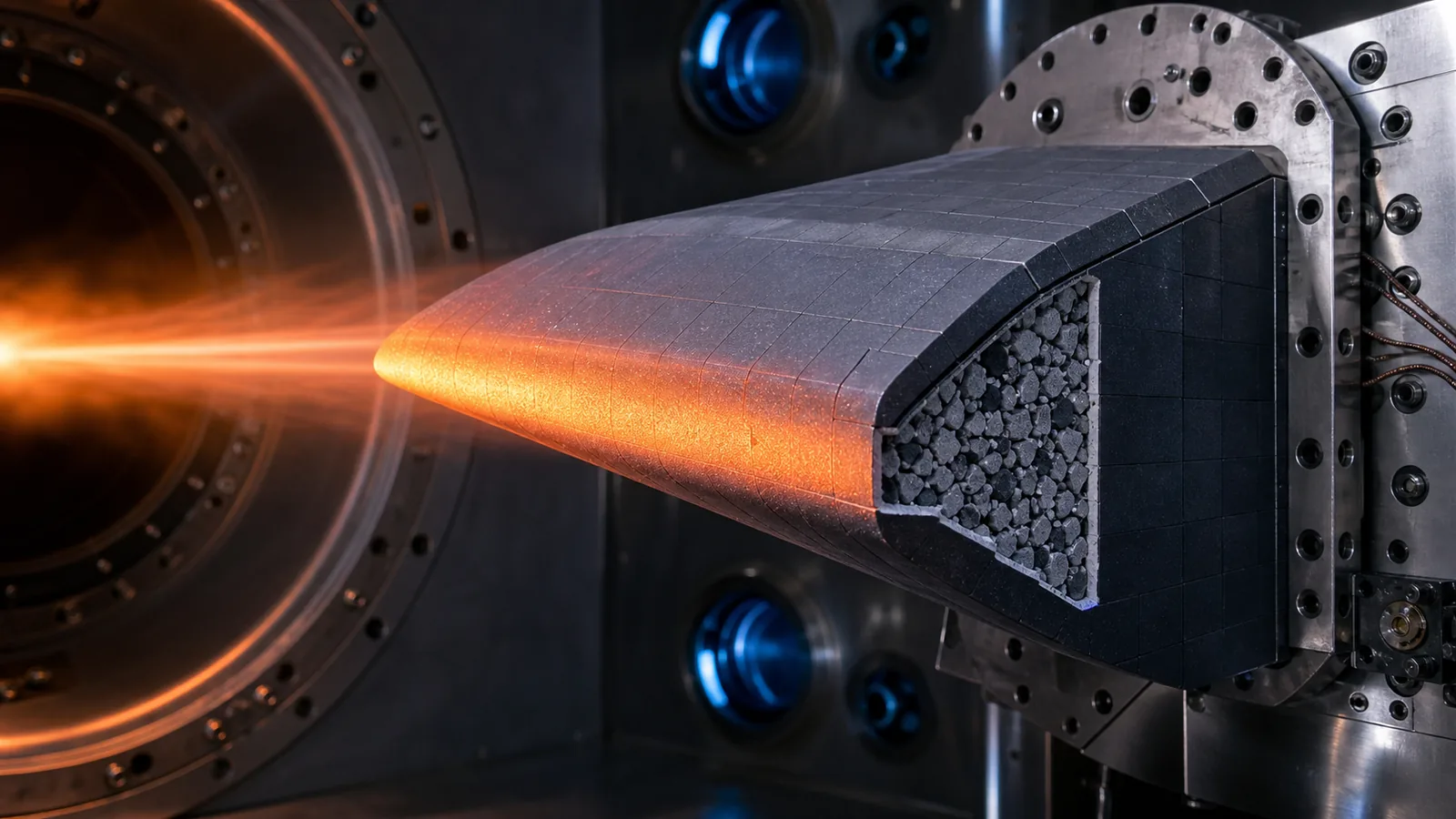
Aerospace components exposed to intense heat flux need more than a material with a high melting point. Ultra-high-temperature ceramic systems must manage oxidation, thermal shock, stress, joining and manufacturability under realistic service conditions.
Why Carbides and Borides Are Considered
Refractory carbides and borides such as ZrC, HfC, ZrB₂ and HfB₂ combine high-temperature capability with useful hardness and thermal properties. They are studied for sharp leading edges, thermal-protection structures, nozzle components and other severe environments.
The final material is often a composite rather than a single phase. Secondary phases, fibers or tailored microstructures may be introduced to improve oxidation behavior, crack resistance, thermal conductivity or processing.
- High-temperature strength and dimensional stability
- Resistance to erosion and high-velocity gas flow
- Thermal conductivity suitable for the component design
- Compatibility with coatings, fibers or adjacent structures
Oxidation Is Often the Governing Challenge
A material can remain solid at an extreme temperature and still fail because its surface reacts rapidly with oxygen. Oxide scale composition, volatility, cracking and adherence influence whether the surface protects the underlying ceramic.
Test conditions should reproduce relevant temperature, pressure, gas composition, heat flux and cycling. Short laboratory exposures can screen materials, but component design requires a broader program including thermal shock, mechanical loading and recession measurement.
| Design Question | Why It Matters | Typical Evidence |
|---|---|---|
| Oxidation and recession | Controls material loss and surface stability | Mass change, cross-section and surface analysis |
| Thermal shock | Rapid gradients can initiate cracks | Cyclic heating and post-test inspection |
| Mechanical integrity | Loads continue at elevated temperature | Strength, fracture and creep-related evaluation |
| Joining and coating | Interfaces may limit the whole component | Bond integrity and thermal-expansion compatibility |
Powder Quality Influences Component Reliability
Particle size, oxygen, carbon balance, phase purity and agglomeration affect mixing, forming and sintering. Inconsistent raw materials can create pores, abnormal grains or secondary phases that become critical under thermal stress.
Development teams should link incoming-powder data to processed microstructure and test performance. This traceability helps identify whether a failure originates in material chemistry, forming, densification, machining, coating or service conditions.
- Define powder chemistry and phase requirements.
- Control dispersion and contamination during mixing.
- Measure density, porosity and microstructure after sintering.
- Use representative thermal and mechanical validation.
Practical Information to Share with a Supplier
A useful technical review starts with complete application information. Include the following details in your inquiry:
- Target temperature, atmosphere and heat flux
- Component geometry and mechanical loads
- Candidate carbide, boride or composite system
- Powder chemistry and particle-size requirements
- Prototype size and planned validation method
Engineering Support from Changyu Advanced Materials
Founded in 2017, Changyu Advanced Materials develops and manufactures advanced ceramic powders, ceramic cutting tools, substrates, thermal-management parts and high-performance ceramic components. Our 50,000 m² site includes more than 300 production units and over 40 analytical and testing instruments.
With 20 national invention patents, participation in five national standards, and ISO 9001-based quality management, our team supports international projects from material selection and sample evaluation through pilot production and repeat supply.
Discuss Your Ceramic Material Project
Send us your target chemistry, particle-size range, drawing, operating conditions, annual demand and required inspection items. Our engineering team will review the most suitable material and supply route.
Contact Our Technical TeamEmail: [email protected]