

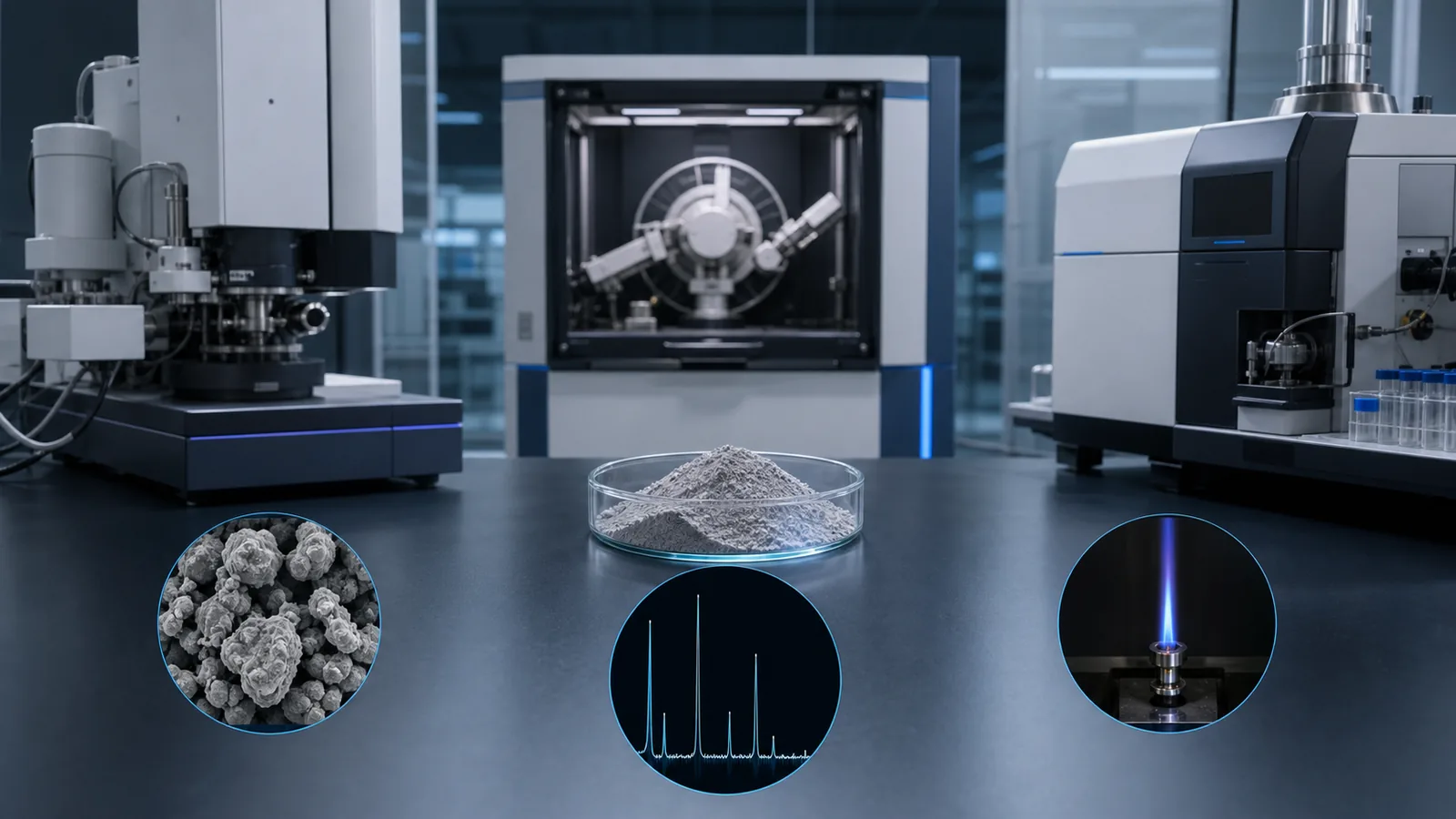
A test is useful only when it answers the correct engineering question. SEM reveals morphology and microstructure, XRD identifies crystalline phases, and ICP-AES measures elemental composition. Combining them can provide a much stronger explanation of a material problem.
SEM: See Shape, Surface and Microstructure
Scanning electron microscopy produces high-magnification images of powder particles, fracture surfaces, coatings and polished cross-sections. It can reveal agglomeration, pore shape, abnormal grains, cracks, inclusions and wear features.
SEM images are descriptive rather than automatically quantitative. Sample preparation, accelerating voltage, detector selection and magnification affect what can be observed. Elemental microanalysis may support local identification, but it is not a replacement for a validated bulk-chemistry method.
- Powder morphology and agglomeration
- Fracture origin and surface defects
- Pore and grain comparison
- Coating thickness and interfacial features
XRD: Identify Crystalline Phases
X-ray diffraction measures the diffraction pattern produced by crystalline structures. It is used to confirm the target phase, detect secondary phases and compare structural changes after processing.
Detection limits depend on phase fraction, crystallinity, peak overlap and measurement conditions. A statement that a phase is not detected does not necessarily mean it is completely absent. Quantitative work requires suitable standards, refinement methods and representative sample preparation.
- Raw-material phase confirmation
- Reaction completion and secondary-phase detection
- Process comparison before and after heat treatment
- Support for failure or contamination investigations
ICP-AES: Measure Bulk Elemental Composition
ICP-AES, also called ICP-OES, measures light emitted by excited elements in a plasma. It is well suited to multi-element analysis after the sample has been brought into solution using a matrix-appropriate preparation route.
The quality of the result depends heavily on digestion, dilution, calibration, matrix effects and reporting limits. Highly refractory ceramics may require specialized dissolution or fusion procedures. Target elements and expected concentration ranges should be agreed before testing.
| Engineering Question | Primary Method | Useful Complement |
|---|---|---|
| What do the particles or defects look like? | SEM | Particle-size analysis or local microanalysis |
| Which crystalline phases are present? | XRD | Chemistry and SEM |
| How much of each target element is present? | ICP-AES | O/N and C/S analysis |
| Why did a batch behave differently? | Combined method plan | PSD, SEM, XRD and chemistry as needed |
Practical Information to Share with a Supplier
A useful technical review starts with complete application information. Include the following details in your inquiry:
- Material composition and sample form
- Engineering question or suspected failure mode
- Target phases, elements or features
- Expected concentration or size range
- Required report format and comparison groups
Engineering Support from Changyu Advanced Materials
Founded in 2017, Changyu Advanced Materials develops and manufactures advanced ceramic powders, ceramic cutting tools, substrates, thermal-management parts and high-performance ceramic components. Our 50,000 m² site includes more than 300 production units and over 40 analytical and testing instruments.
With 20 national invention patents, participation in five national standards, and ISO 9001-based quality management, our team supports international projects from material selection and sample evaluation through pilot production and repeat supply.
Discuss Your Ceramic Material Project
Send us your target chemistry, particle-size range, drawing, operating conditions, annual demand and required inspection items. Our engineering team will review the most suitable material and supply route.
Contact Our Technical TeamEmail: [email protected]