

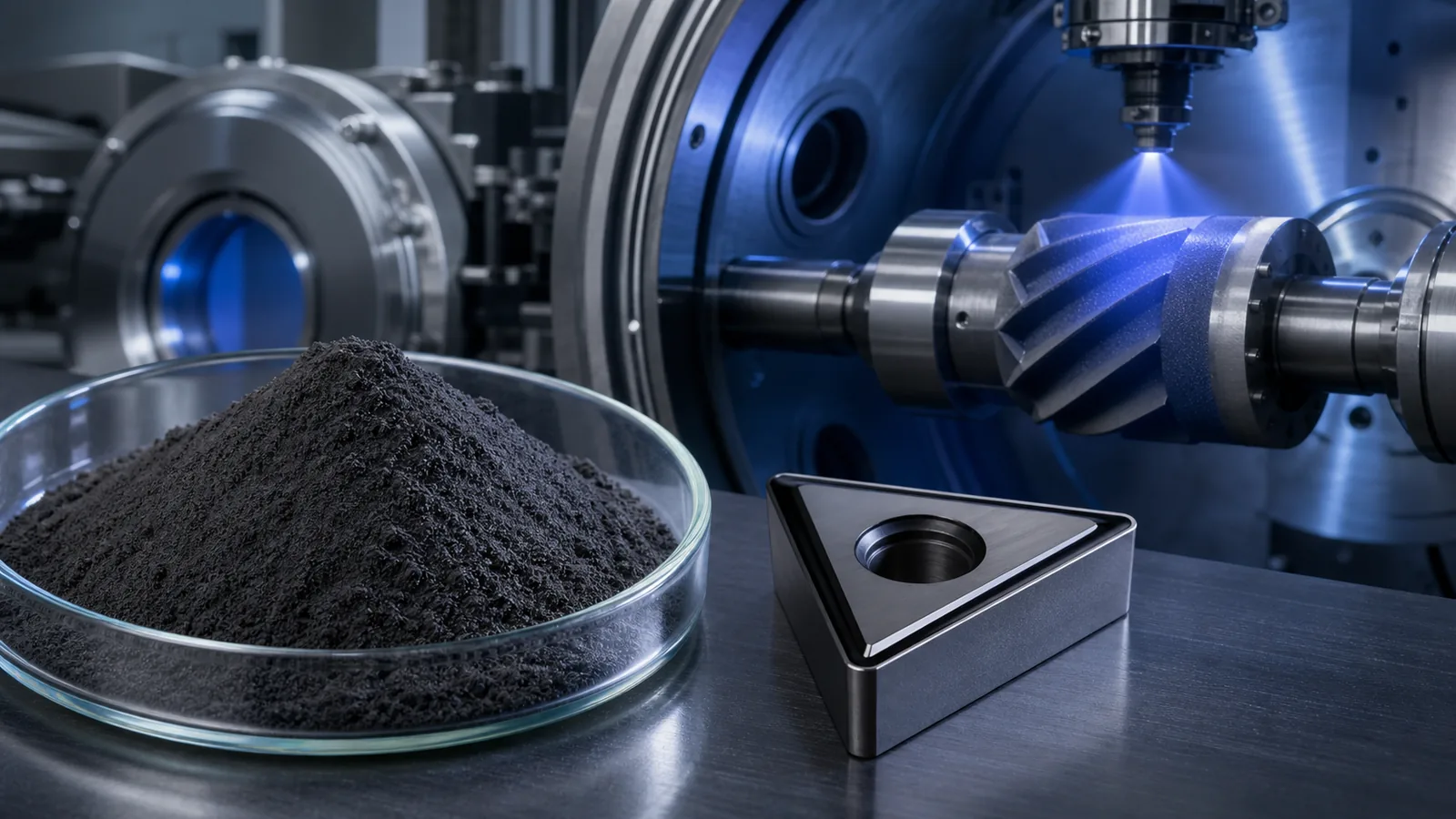
Titanium carbide is valued for hardness, wear resistance and high-temperature stability, but successful use in a cermet or coating depends on how the powder interacts with the metallic or ceramic matrix during processing.
TiC as a Hard Phase in Cermets and Hard Alloys
In a cermet, TiC particles contribute hardness and abrasion resistance while the metallic binder provides toughness and joins the hard phase into a usable body. Wetting, dissolution and reprecipitation during sintering influence grain shape and the final distribution of phases.
Particle size affects mixing and reaction kinetics. Fine powder can support a uniform microstructure, but agglomeration or high surface oxygen may interfere with dispersion and phase control. The binder system and added carbides must be selected as a complete formulation.
- Cutting inserts and wear-resistant tooling
- Wear plates, guides and precision components
- Carbide-reinforced metal or ceramic composites
- Research formulations requiring controlled hard phases
TiC in Wear-Resistant Coatings
TiC may be incorporated into thermal-spray, laser-cladding, deposited or composite coating systems depending on the substrate and service environment. The objective is usually to increase resistance to abrasion, sliding wear or high-temperature degradation.
Coating feedstock requirements are process-specific. Flowability, particle size, morphology and thermal response must suit the delivery and deposition method. The expansion mismatch and bond between coating and substrate are just as important as the hardness of TiC itself.
| Control Area | Cermet Requirement | Coating Requirement |
|---|---|---|
| Particle size | Uniform mixing and controlled sintering | Stable feeding and deposition |
| Oxygen/free carbon | Phase and binder-wetting control | Consistent reaction and coating quality |
| Morphology | Dispersion and green density | Flow and deposition efficiency |
| Matrix compatibility | Binder chemistry and sintering response | Substrate bond and thermal expansion |
Validate the Complete Material System
A powder specification should be connected to finished-material tests. For cermets, this may include density, hardness, transverse strength, microstructure and cutting or wear trials. For coatings, thickness, porosity, adhesion, hardness and service-specific wear are important.
Pilot evaluation is the best way to define a repeatable supply specification. Once the relevant powder and process variables are understood, critical chemistry, particle-size and inspection limits can be formalized for production orders.
- Compare powder lots using aligned analytical methods.
- Record milling and mixing conditions.
- Inspect microstructure before service testing.
- Evaluate failure mode, not only a single hardness value.
Practical Information to Share with a Supplier
A useful technical review starts with complete application information. Include the following details in your inquiry:
- Cermet, coating or composite application
- Binder or substrate composition
- Target particle-size distribution
- Oxygen, carbon and purity limits
- Service wear, temperature and corrosion conditions
Engineering Support from Changyu Advanced Materials
Founded in 2017, Changyu Advanced Materials develops and manufactures advanced ceramic powders, ceramic cutting tools, substrates, thermal-management parts and high-performance ceramic components. Our 50,000 m² site includes more than 300 production units and over 40 analytical and testing instruments.
With 20 national invention patents, participation in five national standards, and ISO 9001-based quality management, our team supports international projects from material selection and sample evaluation through pilot production and repeat supply.
Discuss Your Ceramic Material Project
Send us your target chemistry, particle-size range, drawing, operating conditions, annual demand and required inspection items. Our engineering team will review the most suitable material and supply route.
Contact Our Technical TeamEmail: [email protected]