

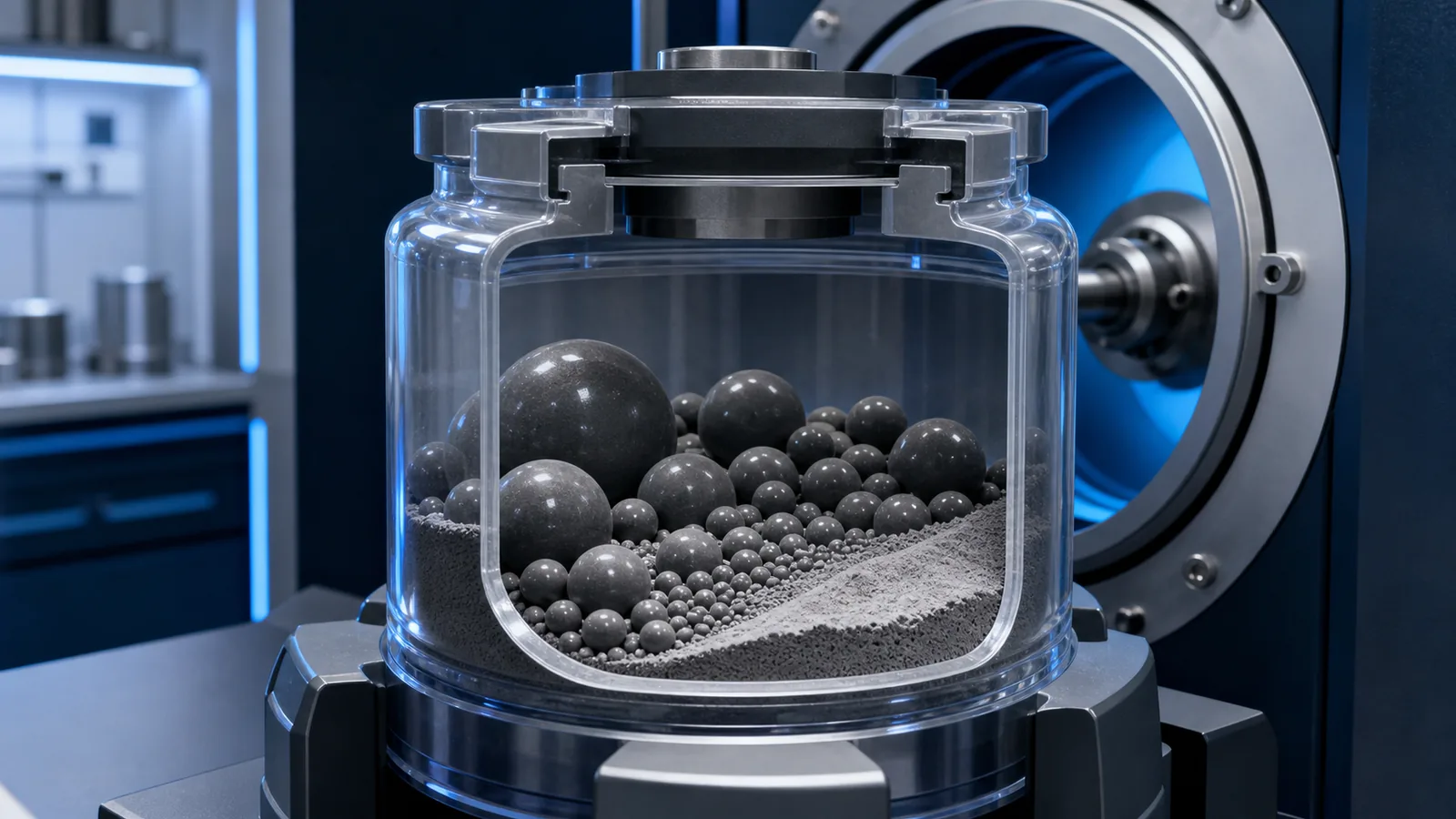
Grinding media transfers mechanical energy to powder, but it also becomes a potential source of contamination and process instability. The correct material, diameter, loading and operating condition depend on the feedstock and target particle size.
Media Material Determines Energy and Contamination
Higher-density media can deliver greater impact energy at the same size and speed. However, media chemistry must be compatible with the powder because wear debris can change composition, color, sintering behavior or functional properties.
Common choices include oxide ceramics, zirconia-based media, silicon nitride, hard metals and specialized cermets. The best option balances density, hardness, fracture resistance, corrosion behavior, cost and the acceptable contamination profile.
| Selection Factor | Effect on Milling | Practical Check |
|---|---|---|
| Density | Changes impact energy and milling rate | Match to mill speed and vessel strength |
| Hardness and wear | Controls service life and debris generation | Measure media loss and powder contamination |
| Fracture resistance | Influences chipping and unexpected fragments | Inspect media and screen powder |
| Chemical compatibility | Prevents reactions or harmful contamination | Analyze critical elements after milling |
Media Size Controls the Energy Distribution
Large balls deliver higher impact energy and are useful for breaking coarse feed, while smaller media provides more contact points and can support fine grinding. A controlled mixture of sizes may improve efficiency when the feed contains a broad range of particles.
Very small media may be ineffective if the mill cannot move it energetically, and excessive large media can reduce contact frequency or damage the vessel. Media size should therefore be selected together with mill type, speed, powder loading and liquid content.
- Feed-particle size and hardness
- Target final particle size
- Wet or dry milling route
- Mill geometry, speed and available power
- Maximum acceptable process temperature
Control the Whole Milling System
Ball-to-powder ratio, filling level, dispersant, solvent, atmosphere and milling time all change the result. A process can appear efficient while introducing contamination, excessive heat or a wide particle-size distribution.
Scale-up should preserve the relevant energy and flow conditions rather than simply multiplying batch quantities. Monitor particle-size distribution, chemistry, powder temperature and media wear throughout development.
- Establish a baseline media-loss rate.
- Inspect balls for flattening, chipping and surface damage.
- Track key contaminant elements in the milled powder.
- Use representative pilot batches before production scale-up.
Practical Information to Share with a Supplier
A useful technical review starts with complete application information. Include the following details in your inquiry:
- Powder composition, hardness and starting size
- Wet or dry milling process
- Mill type, vessel material and operating speed
- Target particle size and acceptable contamination
- Batch size and expected media service life
Engineering Support from Changyu Advanced Materials
Founded in 2017, Changyu Advanced Materials develops and manufactures advanced ceramic powders, ceramic cutting tools, substrates, thermal-management parts and high-performance ceramic components. Our 50,000 m² site includes more than 300 production units and over 40 analytical and testing instruments.
With 20 national invention patents, participation in five national standards, and ISO 9001-based quality management, our team supports international projects from material selection and sample evaluation through pilot production and repeat supply.
Discuss Your Ceramic Material Project
Send us your target chemistry, particle-size range, drawing, operating conditions, annual demand and required inspection items. Our engineering team will review the most suitable material and supply route.
Contact Our Technical TeamEmail: [email protected]