

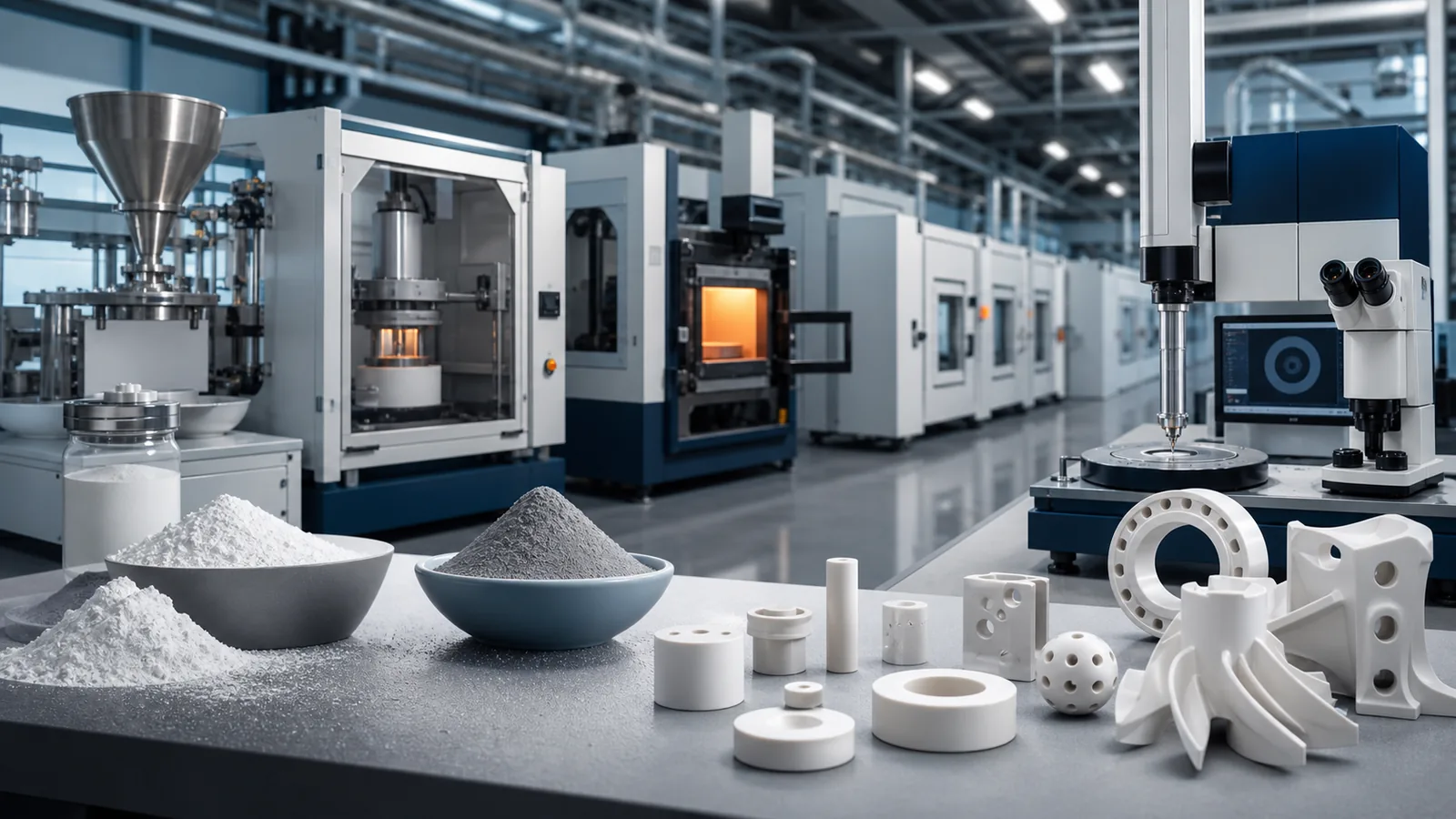
A finished ceramic component reflects every earlier process step. Raw-powder variation, mixing, forming, sintering and machining can each create defects that are difficult or impossible to remove later. Effective quality control links data across the full production chain.
Incoming Powder Control Creates the Baseline
Material identity, phase composition, particle-size distribution and key impurities should be confirmed before production. The required tests depend on whether the feedstock is an oxide, nitride, carbide, boride or composite formulation.
Incoming inspection should use representative sampling and methods aligned with the supplier’s certificate. Trend charts across multiple lots help identify gradual drift that a pass/fail limit may not reveal.
- Chemical composition and critical impurities
- Phase analysis and material identity
- Particle-size distribution and morphology
- Flowability, density and moisture where relevant
Process Controls Prevent Hidden Defects
Mixing and milling must distribute additives uniformly while limiting contamination. Forming controls green density and dimensional consistency. During sintering, atmosphere, heating rate, peak temperature and cooling influence densification, grain growth and residual stress.
A useful control plan identifies critical parameters, measurement frequency, reaction limits and traceability. Data should connect each finished lot to raw materials, equipment, furnace cycle and inspection results.
| Process Stage | Critical Control | Typical Evidence |
|---|---|---|
| Mixing and milling | Homogeneity and contamination | PSD, chemistry and process records |
| Forming | Green density and dimensional uniformity | Weight, dimensions and density checks |
| Sintering | Atmosphere and thermal cycle | Furnace records, density and phase analysis |
| Machining | Surface integrity and tolerances | Dimensional report and surface inspection |
Final Inspection Must Reflect the Application
Dimensions alone do not define component quality. Depending on the application, inspection may include density, hardness, strength, thermal properties, surface finish, flatness, leak tightness, dielectric behavior or microstructure.
The inspection plan should distinguish routine lot-release tests from qualification tests. A complex property that is destructive or expensive may be measured during qualification and audited periodically, while dimensions and appearance are checked more frequently.
- Agree on drawings, datum systems and tolerances.
- Define sampling level and acceptance criteria.
- Specify required certificates and inspection reports.
- Use application trials to confirm that measured properties predict performance.
Integrated Capability Reduces Development Risk
When powder development, analysis, forming, sintering, machining and technical service are connected, feedback moves faster between the material and component teams. This is especially valuable for new geometries, replacement materials and applications without an established specification.
Changyu combines advanced ceramic powder, cutting-tool, substrate and component development with analytical and pilot-scale capability. International customers can begin with a technical review, progress to samples and validation, and then define a repeatable production specification.
Practical Information to Share with a Supplier
A useful technical review starts with complete application information. Include the following details in your inquiry:
- Component drawing and functional requirements
- Material grade or target properties
- Operating temperature, load and environment
- Inspection standards and documentation
- Prototype quantity, production volume and delivery schedule
Engineering Support from Changyu Advanced Materials
Founded in 2017, Changyu Advanced Materials develops and manufactures advanced ceramic powders, ceramic cutting tools, substrates, thermal-management parts and high-performance ceramic components. Our 50,000 m² site includes more than 300 production units and over 40 analytical and testing instruments.
With 20 national invention patents, participation in five national standards, and ISO 9001-based quality management, our team supports international projects from material selection and sample evaluation through pilot production and repeat supply.
Discuss Your Ceramic Material Project
Send us your target chemistry, particle-size range, drawing, operating conditions, annual demand and required inspection items. Our engineering team will review the most suitable material and supply route.
Contact Our Technical TeamEmail: [email protected]