

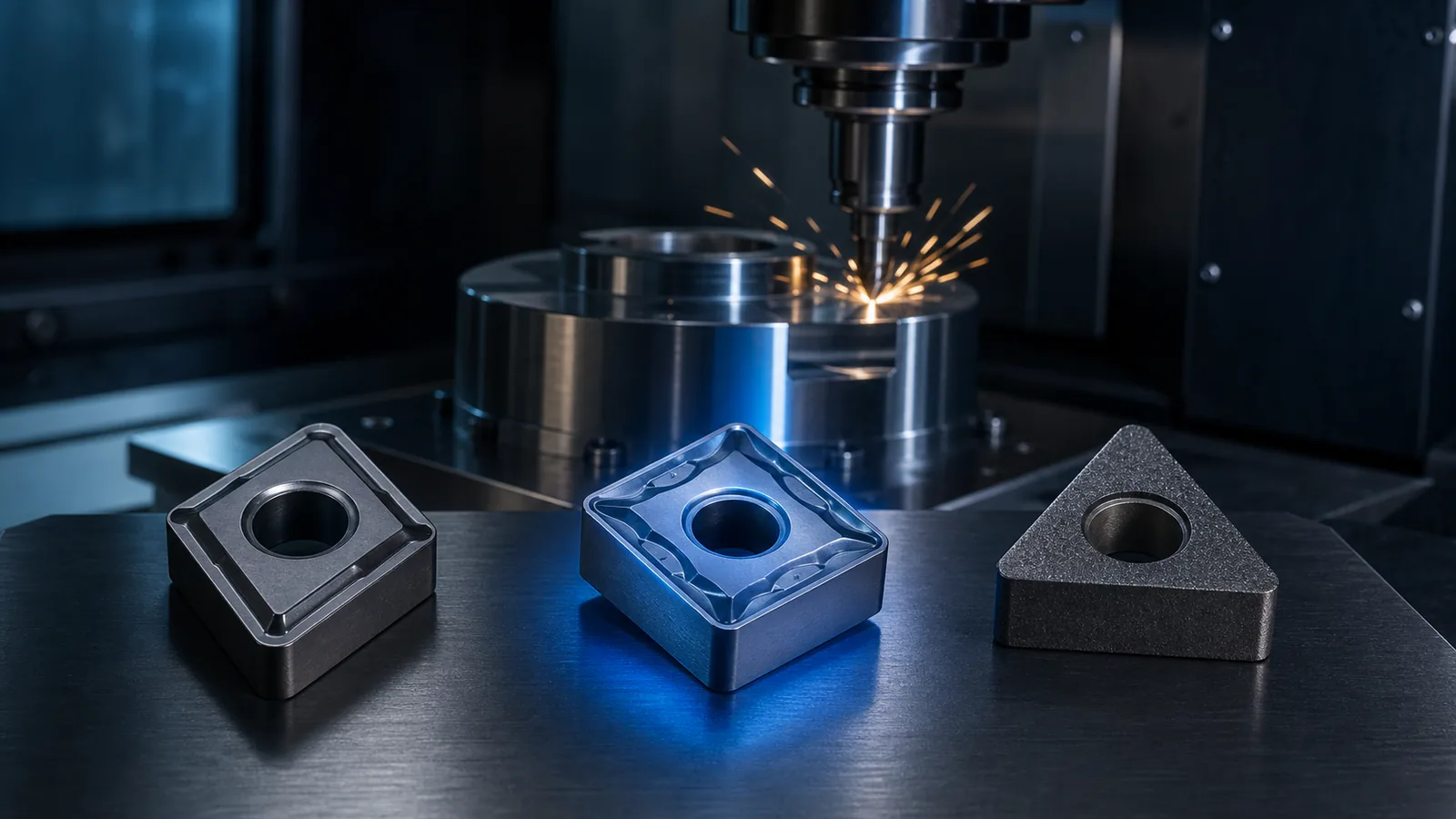
No cutting-tool material is best for every operation. Cemented carbide offers broad usability, CBN targets demanding hardened-material applications, and advanced ceramics can deliver high-speed performance when heat resistance and wear resistance are more important than impact toughness.
Understand the Machining Window
Carbide is often the baseline choice because it tolerates a wide range of cutting conditions and workpiece materials. CBN is valuable for hardened steels and other applications where high hot hardness and chemical stability justify the higher insert cost.
Ceramic tools can operate at elevated cutting speeds and retain hardness at temperatures that challenge many carbide grades. Their lower fracture toughness means that machine rigidity, toolholder condition, edge preparation and interruption level must be controlled.
| Tool Material | Typical Strength | Key Limitation | Common Evaluation Area |
|---|---|---|---|
| Cemented carbide | Versatility and toughness | Hot hardness can limit very high-speed service | General turning and milling |
| Advanced ceramic | Hot hardness and wear resistance | Sensitive to impact and unstable setups | Cast iron, superalloys and selected hardened materials |
| CBN | Performance in hardened ferrous materials | Higher cost and application-specific economics | Finish turning of hardened steel |
Machine Stability Is a Material Requirement
Ceramic inserts should be applied on rigid machines with secure clamping and minimal runout. Worn holders, excessive overhang or unstable workholding can create impact loads that produce edge chipping before the ceramic grade reaches its wear potential.
Edge geometry is equally important. Honing, chamfering and nose radius must match the workpiece, feed and interruption level. A stronger edge can resist chipping, while a sharper edge may be needed to control cutting forces in a stable finishing operation.
- Confirm machine rigidity and spindle condition.
- Use a stable toolholder with correct insert support.
- Avoid unexpected interruptions and scale when possible.
- Match edge preparation to feed and depth of cut.
- Evaluate coolant strategy according to the ceramic grade and operation.
Compare Cost per Component, Not Insert Price
A premium insert can reduce total cost if it increases cutting speed, shortens cycle time, improves dimensional consistency or reduces tool changes. Conversely, a technically advanced material may be uneconomical if the machine cannot use the required parameters.
A controlled trial should compare tool life, cycle time, surface finish, dimensional drift and failure mode. Record the actual cutting conditions and inspect the used edge so that grade or geometry changes are based on evidence.
- Workpiece material, hardness and microstructure
- Continuous or interrupted cutting
- Speed, feed and depth of cut
- Surface-finish and dimensional targets
- Target tool life and acceptable failure mode
Practical Information to Share with a Supplier
A useful technical review starts with complete application information. Include the following details in your inquiry:
- Workpiece grade, hardness and condition
- Operation, interruption ratio and stock allowance
- Existing insert geometry and toolholder
- Current speed, feed, depth of cut and coolant
- Tool-life, finish and productivity target
Engineering Support from Changyu Advanced Materials
Founded in 2017, Changyu Advanced Materials develops and manufactures advanced ceramic powders, ceramic cutting tools, substrates, thermal-management parts and high-performance ceramic components. Our 50,000 m² site includes more than 300 production units and over 40 analytical and testing instruments.
With 20 national invention patents, participation in five national standards, and ISO 9001-based quality management, our team supports international projects from material selection and sample evaluation through pilot production and repeat supply.
Discuss Your Ceramic Material Project
Send us your target chemistry, particle-size range, drawing, operating conditions, annual demand and required inspection items. Our engineering team will review the most suitable material and supply route.
Contact Our Technical TeamEmail: [email protected]