

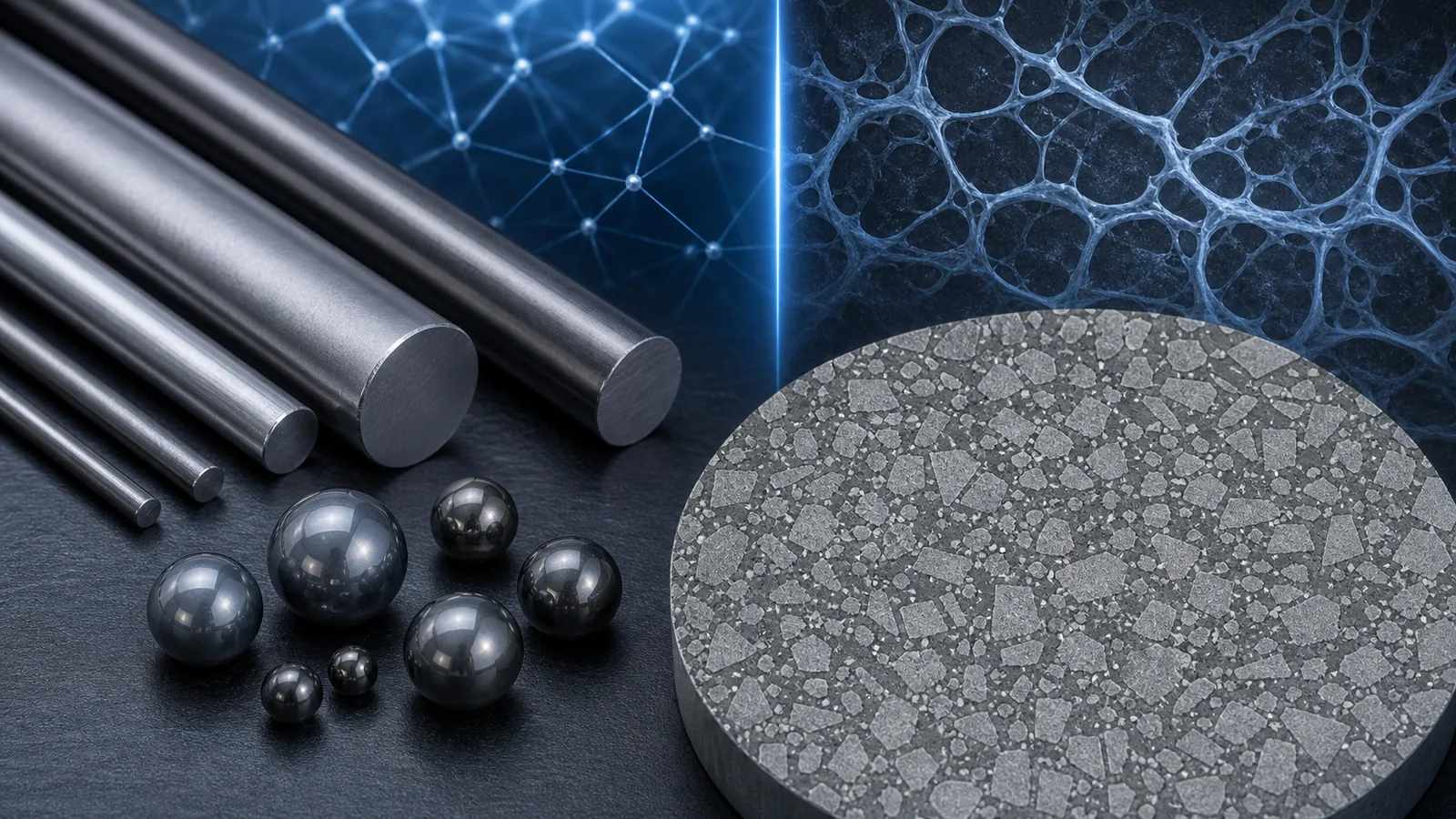
Ti(C,N)-based cermets are designed to combine the hot hardness and wear resistance of ceramic phases with the toughness and processability provided by a metallic binder. Performance depends on the balance between these phases, not on either one alone.
How the Composite Structure Works
The Ti(C,N)-based hard phase carries much of the wear and thermal load, while the metallic binder connects hard grains and helps resist catastrophic fracture. Additional carbide-forming elements may be used to adjust wetting, grain growth, oxidation behavior and high-temperature properties.
A well-controlled microstructure distributes hard grains uniformly and limits large pores, brittle clusters and binder-rich regions. The target structure varies by application: a cutting insert, wear pin and grinding ball do not require the same hardness-to-toughness ratio.
| Design Variable | If Increased or Refined | Trade-Off to Review |
|---|---|---|
| Hard-phase fraction | Can improve hardness and wear resistance | May reduce fracture tolerance |
| Binder content | Can improve toughness and manufacturability | May reduce hot hardness |
| Grain refinement | Can improve uniformity and strength | Requires tighter powder and sintering control |
| Residual porosity | Lower porosity generally supports reliability | Densification conditions may affect grain growth |
Processing Determines the Final Microstructure
Powder mixing must distribute the ceramic and binder phases without introducing contamination. Forming should provide uniform green density, and the sintering cycle must promote densification while controlling grain growth and binder movement.
After sintering, precision grinding or polishing may be required to achieve final dimensions and surface condition. Finishing allowance should be agreed before the blank is produced because cermets require appropriate diamond tooling and stable machining conditions.
- Powder chemistry and particle-size compatibility
- Homogeneous mixing and contamination control
- Green density and dimensional allowance
- Sintering temperature, atmosphere and time
- Final grinding, polishing and dimensional inspection
Select Properties Around the Failure Mode
Abrasive wear, thermal cycling, impact, rolling contact and corrosion create different demands. A material that performs well in steady sliding wear may not be suitable for impact loading. Engineers should define the dominant failure mechanism before selecting a cermet grade.
Prototype parts and representative service tests are especially important when replacing hardened steel, carbide or conventional ceramics. The evaluation should include wear rate, edge damage, dimensional stability and the condition of mating components.
- Wear-resistant pins, guides and precision blanks
- Grinding media for hard powder systems
- Tool and fixture components
- Parts exposed to abrasion and moderate thermal cycling
Practical Information to Share with a Supplier
A useful technical review starts with complete application information. Include the following details in your inquiry:
- Part drawing, tolerances and surface requirements
- Dominant wear, load and temperature conditions
- Current material and observed failure mode
- Required finishing allowance
- Prototype and production quantities
Engineering Support from Changyu Advanced Materials
Founded in 2017, Changyu Advanced Materials develops and manufactures advanced ceramic powders, ceramic cutting tools, substrates, thermal-management parts and high-performance ceramic components. Our 50,000 m² site includes more than 300 production units and over 40 analytical and testing instruments.
With 20 national invention patents, participation in five national standards, and ISO 9001-based quality management, our team supports international projects from material selection and sample evaluation through pilot production and repeat supply.
Discuss Your Ceramic Material Project
Send us your target chemistry, particle-size range, drawing, operating conditions, annual demand and required inspection items. Our engineering team will review the most suitable material and supply route.
Contact Our Technical TeamEmail: [email protected]