

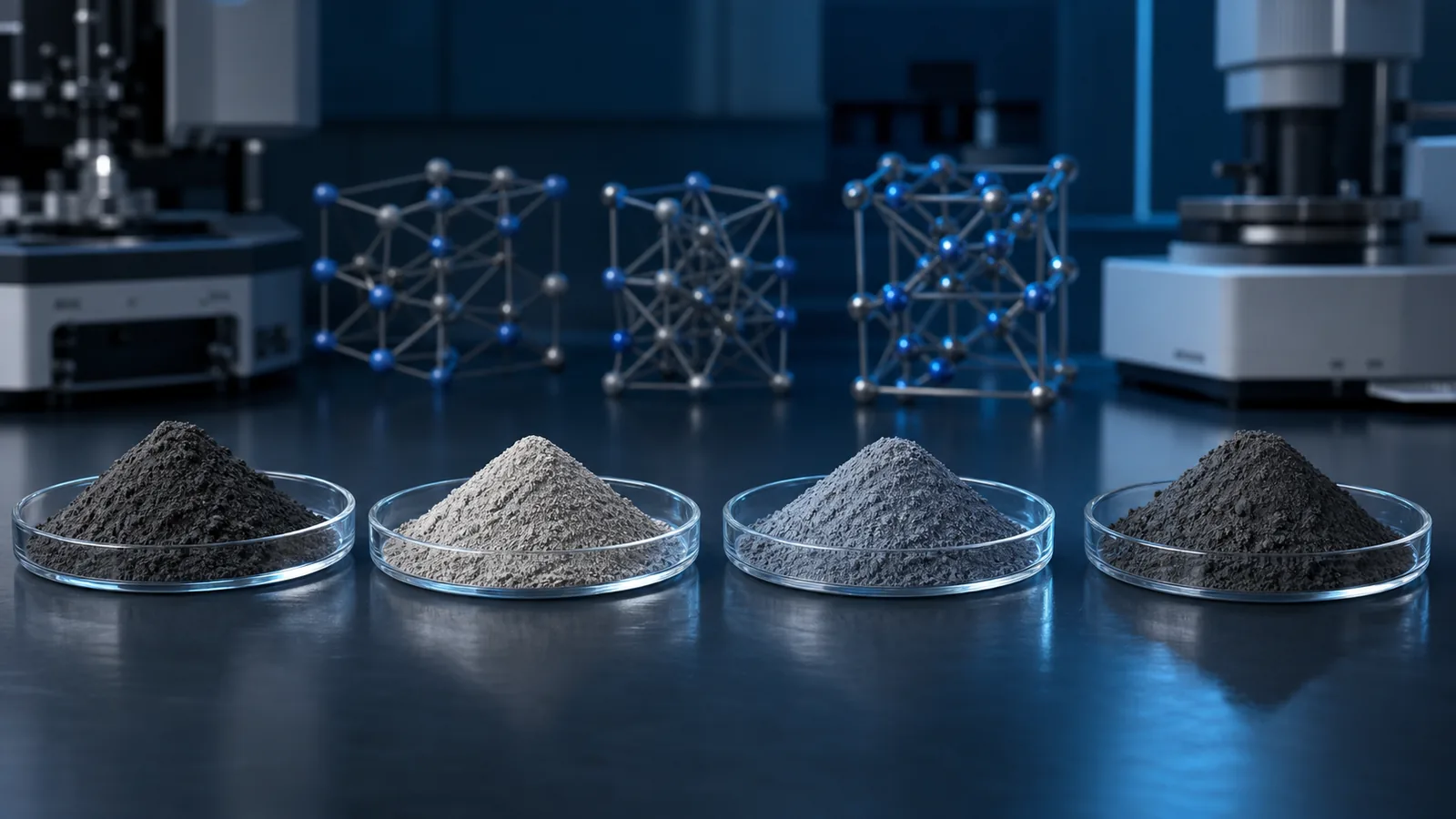
Selecting a non-oxide ceramic powder is not simply a matter of choosing the material with the highest hardness or melting point. The right grade must match the operating environment, manufacturing process, target microstructure and cost of the finished component.
Start with the Required Function
Transition-metal carbides and carbonitrides are used because they retain useful properties in conditions where conventional materials may soften, oxidize or wear rapidly. However, each project emphasizes a different combination of hot hardness, thermal stability, electrical behavior, chemical compatibility and sintering response.
For a cutting-material formulation, compatibility with the binder and resistance to diffusion wear may dominate. For an aerospace thermal-protection component, high-temperature stability and oxidation-management strategy become more important. Coating projects may prioritize deposition behavior, particle morphology and interfacial compatibility.
- TiC: widely used in cermets, hard alloys, wear-resistant composites and coatings.
- ZrC: considered for ultra-high-temperature ceramics, thermal-protection systems and refractory composites.
- HfC: selected for research and severe thermal environments where extreme-temperature capability is central.
- NbC: used in cutting materials, wear-resistant systems and high-temperature alloy or carbide formulations.
- TiCN: offers composition-dependent combinations of hardness, toughness and chemical behavior for cermets and tools.
Compare Chemistry, Particle Size and Surface Condition
Powder chemistry affects phase formation, densification and the properties of the final body. Buyers should review total carbon, free carbon, oxygen, nitrogen and other specified impurities instead of relying on a single headline purity value. The acceptable limits depend on the material system and downstream process.
Particle size also changes packing, dispersion, reaction rate and sintering activity. A finer powder may improve homogeneity and densification, but it can be more sensitive to agglomeration and surface oxygen. A narrow, controlled distribution is often more useful than an unrealistically low average particle size.
| Selection Factor | Why It Matters | Questions to Ask |
|---|---|---|
| Phase and chemistry | Controls reactions, secondary phases and final properties | Which elements and impurity limits are critical? |
| Particle-size distribution | Influences packing, mixing, sintering and coating behavior | Are D10, D50, D90 or a custom range required? |
| Oxygen and free carbon | Can affect wetting, phase balance and process stability | Which analytical method and acceptance limit will be used? |
| Morphology and agglomeration | Influence dispersion, flow and green density | Is SEM evidence or dispersion testing required? |
Match the Powder to the Manufacturing Route
Pressing, slurry processing, spray drying, hot pressing, pressureless sintering, additive manufacturing and thermal spraying impose different powder requirements. A grade that performs well in one process may require different granulation, surface treatment or particle-size control for another.
Before scaling up, a representative sample should be evaluated with the actual binder, dispersant, furnace atmosphere and forming conditions. Recording green density, shrinkage, phase composition and final microstructure provides more useful evidence than comparing certificates alone.
- Confirm whether the powder will be milled, granulated or used as received.
- Define the binder system, solvent, atmosphere and peak processing temperature.
- Agree on sampling, analytical methods and lot-to-lot acceptance criteria.
- Run a pilot batch before committing to production-scale supply.
Practical Information to Share with a Supplier
A useful technical review starts with complete application information. Include the following details in your inquiry:
- Target material and application
- Required chemistry and impurity limits
- Particle-size range or D10/D50/D90 targets
- Forming, sintering or coating process
- Trial quantity and expected annual demand
Engineering Support from Changyu Advanced Materials
Founded in 2017, Changyu Advanced Materials develops and manufactures advanced ceramic powders, ceramic cutting tools, substrates, thermal-management parts and high-performance ceramic components. Our 50,000 m² site includes more than 300 production units and over 40 analytical and testing instruments.
With 20 national invention patents, participation in five national standards, and ISO 9001-based quality management, our team supports international projects from material selection and sample evaluation through pilot production and repeat supply.
Discuss Your Ceramic Material Project
Send us your target chemistry, particle-size range, drawing, operating conditions, annual demand and required inspection items. Our engineering team will review the most suitable material and supply route.
Contact Our Technical TeamEmail: [email protected]