

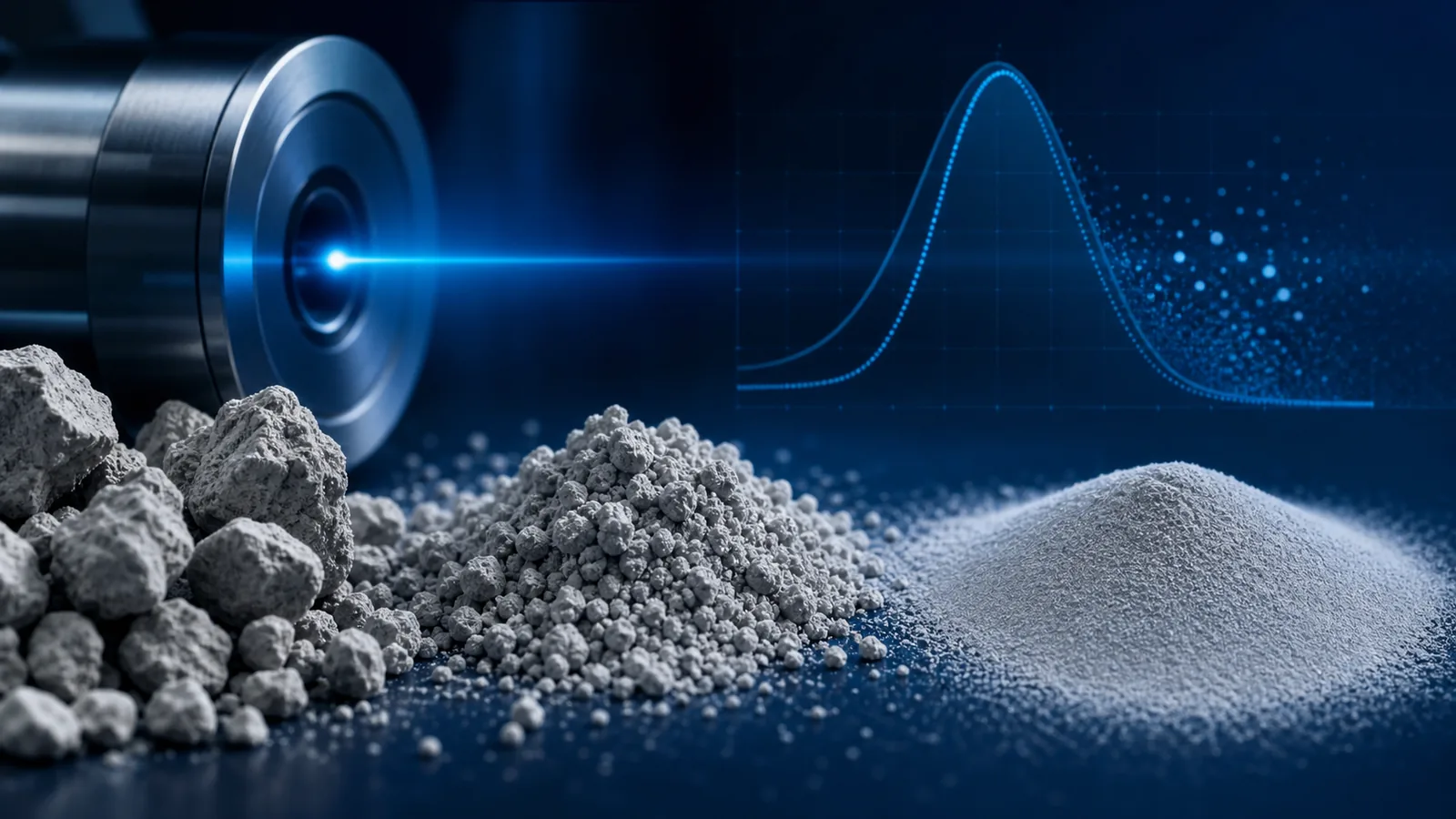
An average particle size cannot describe how a ceramic powder will behave in mixing, forming or sintering. Engineers need the full distribution, the measurement method and an understanding of agglomeration to predict process performance.
What D10, D50, D90 and Span Actually Tell You
D10 is the size below which 10% of the measured particle volume falls, D50 is the median, and D90 describes the coarse end of the distribution. Together they show whether a powder is narrowly controlled or contains a significant fine or coarse tail.
Span is commonly used as a simple indication of distribution width. A lower span generally indicates a narrower distribution, but the best range depends on the application. Some forming systems benefit from a designed combination of fine and coarser particles because smaller particles can fill spaces between larger ones.
| Indicator | Engineering Meaning | Potential Risk |
|---|---|---|
| D10 | Fine fraction of the powder | Excess fines may increase surface area, oxygen pickup and dispersant demand |
| D50 | Median particle size | Useful for comparison, but insufficient on its own |
| D90 | Coarse tail of the distribution | Oversized particles may create defects, roughness or incomplete reaction |
| Span | Relative distribution width | A wide or unstable span can signal inconsistent milling or classification |
Particle Size Changes Every Processing Step
During slurry preparation, small particles create a larger surface area that must be wetted and stabilized. This can increase viscosity and dispersant demand. In dry pressing, distribution and agglomerate strength influence die filling, green density and density gradients.
During sintering, finer particles usually provide greater driving force for densification, but their higher reactivity can also accelerate grain growth or unwanted reactions. In coatings, coarse particles may reduce surface finish, while excessive fines can affect feeding and deposition efficiency.
- Packing density and green-body uniformity
- Slurry viscosity, dispersion stability and sedimentation
- Reaction rate and sintering temperature window
- Final grain size, residual porosity and surface finish
- Powder feeding, spray behavior and coating consistency
Measurement Method and Sample Preparation Matter
Laser diffraction is widely used for ceramic powders, but the result depends on wet or dry dispersion, refractive-index settings, ultrasound energy and analysis model. An agglomerated powder can appear much coarser if dispersion conditions are insufficient.
A reliable specification should define the instrument class, dispersion medium, sample preparation, repeat count and reporting basis. SEM imaging provides complementary evidence about morphology and agglomeration, while powder-flow and density testing help connect particle data to production behavior.
- Use the same validated method for supplier qualification and incoming inspection.
- Record whether results represent primary particles or dispersed agglomerates.
- Review the complete curve instead of accepting only D50.
- Monitor trend data across multiple lots to detect process drift.
Practical Information to Share with a Supplier
A useful technical review starts with complete application information. Include the following details in your inquiry:
- Material composition and expected size range
- Wet or dry measurement preference
- Required D10, D50, D90 and span
- Downstream forming or coating process
- Need for SEM, flowability or density data
Engineering Support from Changyu Advanced Materials
Founded in 2017, Changyu Advanced Materials develops and manufactures advanced ceramic powders, ceramic cutting tools, substrates, thermal-management parts and high-performance ceramic components. Our 50,000 m² site includes more than 300 production units and over 40 analytical and testing instruments.
With 20 national invention patents, participation in five national standards, and ISO 9001-based quality management, our team supports international projects from material selection and sample evaluation through pilot production and repeat supply.
Discuss Your Ceramic Material Project
Send us your target chemistry, particle-size range, drawing, operating conditions, annual demand and required inspection items. Our engineering team will review the most suitable material and supply route.
Contact Our Technical TeamEmail: [email protected]